


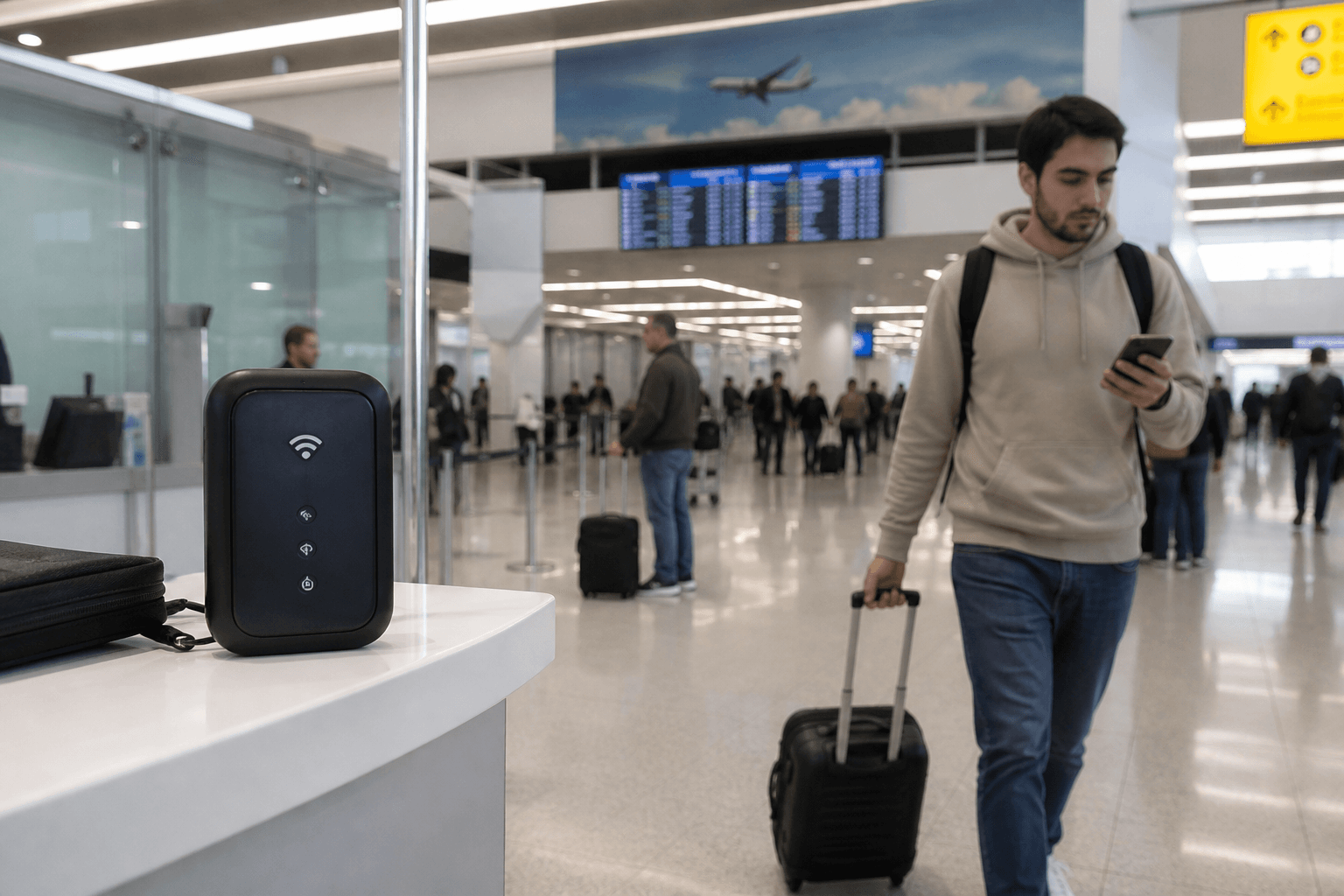
At JFK or LAX two queues. One waits for a pocket Wi-Fi. The other already has data: a travel eSIM installed before Heathrow. Pocket Wi-Fi vs eSIM is not a draw. Compatible unlocked mobile: take the eSIM. The box only comes back when the eSIM does not hold.
This guide compares travel eSIM and pocket Wi-Fi for everyone: solo, couple, family, group, business, mobile with no eSIM. Hosts stay the same (T-Mobile, Verizon, AT&T). Detail in the network guide. Plans sit on the United States comparison.
Supplier links are affiliates. They do not move the eSIM verdict or the catalog prices. Detail in the methodology.
eSIM or pocket Wi-Fi in the United States: the verdict
| Criterion | Travel eSIM | Airport pocket Wi-Fi |
|---|---|---|
| Purchase | Before the flight, 2 minutes | Counter, passport, often a deposit |
| JFK / EWR / LAX / SFO queue | No | Yes, desk hours |
| Kit to carry | None | Box + cable + sometimes a battery |
| Host | The one written on the plan | Often T-Mobile / AT&T / Verizon, not always readable |
| Sharing | Phone hotspot | One Wi-Fi for N devices |
| Home bank SMS | Home line kept | Same, the box does not receive your OTPs |
| Return | Nothing | Return queue, lost kit = invoice |
Rule: eSIM-ready phone, 1 to 3 lines, 5 to 21 days: eSIM. Large group, tablets with no radio, operator-locked Galaxy with no eSIM: pocket Wi-Fi or plastic SIM. EE, Vodafone, Three or giffgaff roaming in the United States remains the worst of the three, except a rare SKU written on the factsheet (French Free Max, travel pass). See the roaming guide.
Three eSIMs we track, useful once the phone passes the check:

CodeESIMP15

CodeSIMP

CodeESIMP
Who it is for: solo, family, group, business
| Profile | Pick | Why |
|---|---|---|
| Solo, compatible iPhone / Pixel / Galaxy | eSIM | Maps in the pocket, zero queue |
| Couple, two unlocked mobiles | 2 eSIMs (or 1 + tethering) | Less kit than a box, each has a bar |
| Family, 2 adults + kids / tablets | Adult eSIMs + hotspot | Kids follow Maps without a counter |
| Group of 5+ wanting one Wi-Fi | Pocket Wi-Fi or 2 eSIMs + hotspot | The box wins if nobody wants to share battery |
| Business, laptop | eSIM + tethering | The LAX queue costs more than an hour of data |
| Older traveller, uneasy with a QR | eSIM installed at home (help from family) | The desk is not simpler once the deposit is paid |
| Teens, one plan for the gang | 1 eSIM + hotspot, or a box if 6 phones | Count the lines, not "the United States" |
| Mobile with no eSIM | Plastic SIM or pocket Wi-Fi | The eSIM is not relevant. Check the model first |
A reader with no eSIM in the phone is not "behind". They need a different tool. The rest of this guide assumes a compatible SKU, the usual case on our catalog.
What pocket Wi-Fi actually wins
The box is not a 2015 gadget. It wins three cases, no more.
- Many devices, one radio. Four kids' tablets, two phones with no stable hotspot: a pocket Wi-Fi avoids draining the parent's battery.
- No eSIM. Operator-locked Galaxy, old iPhone. The QR will not install. The eSIM compatibility tool says so before purchase, not at JFK.
- You refuse tethering. Some eSIM plans cut hotspot (fair-use). A box remains an access point, even if the host behind it is the same MNO.
The rest (comfort, "that is what the agency put in the quote") is not an argument. T-Mobile shows 91.8% 5G availability (Opensignal July 2026). An old 4G pocket Wi-Fi will not see it. A recent 4G/5G eSIM will, if the host declares it.
In the United States pocket Wi-Fi is less cultural than at BKK. Fewer desks, more online rental (Tep, Solis) to collect. That does not make it simpler. It adds a return address.
What the eSIM wins (almost always)
Friction. Buy from the sofa. Install on home Wi-Fi. Activate on landing. No deposit, no desk hours, no return on the flight home.
Weight. The phone you already have. No lanyard, no dedicated power bank for the box. In a park, one fewer object.
Readable host. On our side the host networks column says T-Mobile, AT&T or Verizon. A pocket Wi-Fi counter often sells "USA 4G" without naming the host. Same radio, less information.
Home line. The United States eSIM is almost always data only. You keep Monzo, Revolut, PayPal, high-street and HMRC on the home SIM. Pocket Wi-Fi changes nothing on that point. It does not simplify it either.
The network ranking applies to both tools. A Verizon pocket Wi-Fi at Zion is not more magic than a Verizon eSIM. Pick the host, not the plastic.
| Provider | Typical host | Code | Offer | Review |
|---|---|---|---|---|
| Airalo | T-Mobile (often) | ESIMP15 | Offer | Review |
| Ubigi | check live | ESIMP | Offer | Review |
| Holafly | check live | SIMP | Offer | Review |
 Nomad Nomad | check live | ESIMPNOMAD | Offer | Review |
 Saily Saily | check live | ESIMG | Offer | Review |

Estimate gigabytes for maps, video and hotspot.
Open calculatorPHONEeSIM compatibilityCheck iPhone, Pixel and Galaxy before you buy. EE, Vodafone or Three SKUs are not always eSIM.
Check my phoneHow much data for your trip in the United States?
Three typical trips, same maths as the calculator, North America factor. Maps, Uber, Reels or a laptop on tethering: the same gigabytes on an eSIM or a pocket Wi-Fi box. Turn off photo backup on cellular if you want the low end. Read the fair use.
Estimate 8.3 GB · Maps, chat, Instagram. No Reels, no laptop.
Estimate 16.5 GB · Same base, plus half an hour of video a day.
Estimate 31.6 GB · One hour of phone tethering a day for the computer.
Mistakes that still cost money
- Taking pocket Wi-Fi « because it is simpler »
Queue, deposit, return. An eSIM installed at home is the simplest move once the phone is compatible.
Check compatibility - Staying on UK roaming to avoid the choice
Often dearer, worse radio than an eSIM on T-Mobile or Verizon. The box does not fix the carrier bill either.
Compare USA eSIMs - One box for two adults who each have an iPhone
Two eSIMs, or one plus tethering. Pocket Wi-Fi wins mainly from a real group.
Compare USA eSIMs - Scanning the QR on a phone with no eSIM, at JFK
The test happens before you buy. Fail: plastic SIM or rental, not a QR in the queue.
Check compatibility - Believing the box magically picks the best network
It rides the same MNOs. Read the host, as for an eSIM.
Host table
FAQ
eSIM or pocket Wi-Fi in the United States in 2026?
If the phone is compatible and unlocked, take the eSIM. Pocket Wi-Fi wins for a large group, tablets with no radio, or a phone with no eSIM. Not for an unlocked iPhone and ten days in Manhattan.
Is pocket Wi-Fi cheaper than a USA eSIM?
Rarely, once you count the deposit, rental days and the JFK / LAX queue. An eSIM is paid in two minutes and installs before the flight. Compare €/GB on the USA catalog, not the counter poster.
Can I share an eSIM with the family?
Yes, with tethering (hotspot in the iPhone UI). One adult line covers tablets and the kids’ Maps. Two or three eSIMs stay cleaner than a box if everyone has a phone.
Where do I pick up pocket Wi-Fi at JFK or LAX?
Rental desks (Tep, Solis and similar), passport, often a deposit or card. Limited hours. An eSIM installed at home skips that jet-lag queue.
What if my phone has no eSIM?
Then the eSIM is not relevant. Plastic SIM or pocket Wi-Fi. Check the model in the compatibility tool before you buy a QR.
Does the box pick the best US network?
No. It rides T-Mobile, AT&T or Verizon, like an eSIM. Read the host. An old 4G box will not see the 91.8% 5G time Opensignal gives T-Mobile.
Sources
All external sources open in a new tab.
- Opensignal, United States Mobile Network Experience Report, July 2026.
- eSIM Giga catalog: United States comparison.
- Sibling guides: best mobile network in the United States, eSIM or local SIM, Internet in the United States, roaming or eSIM.
A travel eSIM and a pocket Wi-Fi often ride the same MNOs. What changes is the queue, the deposit, and the bank SMS. Once the phone is compatible, we stay on the eSIM.