

In Japan you almost never buy “an eSIM network”. You buy access to a local operator: NTT Docomo, au (KDDI), SoftBank, sometimes Rakuten Mobile. The eSIM brand (Airalo, Holafly, PlanJapon, Ubigi) is a reseller. If the plan sits on the wrong host for your route, Maps drops in the shinkansen, Instagram crawls in Niseko, and the “5G” on the pack does nothing.
This guide ranks the four Japanese MNOs for a visitor, not a local subscriber. Scores come from field experience studies (Opensignal, Japan report April 2026), subscriber volumes (TCA, FY2025), and the host each travel eSIM declares, the same field as the networks table on the Japan comparison.
Links to suppliers are affiliate links. They do not move the network ranking or the catalog prices. Detail in the methodology.
Docomo, au (KDDI) or SoftBank: which network in Japan?
| Rank | Network | Who it is for | Measured strength | Traveller weakness |
|---|---|---|---|---|
| 1 | NTT Docomo | Honshu, Hokkaido, rural, shinkansen | Widest geographic footprint (overall and 5G coverage) per Opensignal | Less often #1 on urban usage quality |
| 2 | au (KDDI) | Tokyo, Osaka, Kyoto, day-to-day (video, maps, VoIP) | Most experience awards (video, games, voice, reliability, consistent quality) | Geographic coverage behind Docomo |
| 3 | SoftBank | Dense cities, download speed and time on 5G | Download Speed Experience and Time on 5G (27.4% of time on 5G, April 2026 report) | Less useful once you leave urban corridors |
| 4 | Rakuten Mobile | Almost never the right tourist eSIM | Best upload (overall and 5G) | Own network still more urban, rare as a travel eSIM host |
Simple rule: pick Docomo if the itinerary leaves Tokyo, Osaka and Kyoto. Pick au (KDDI) if you stay in metros and want the most stable day-to-day connection. SoftBank is the “speed” pick in town. Skip Rakuten unless the plan names it, and even then check you are not sleeping in the countryside.
What the studies actually measure
Opensignal: experience, not 5G ads
The Japan report for April 2026 aggregates user measurements from 1 January to 31 March 2026. This is not a lab drive test. It is what phones see in the wild.
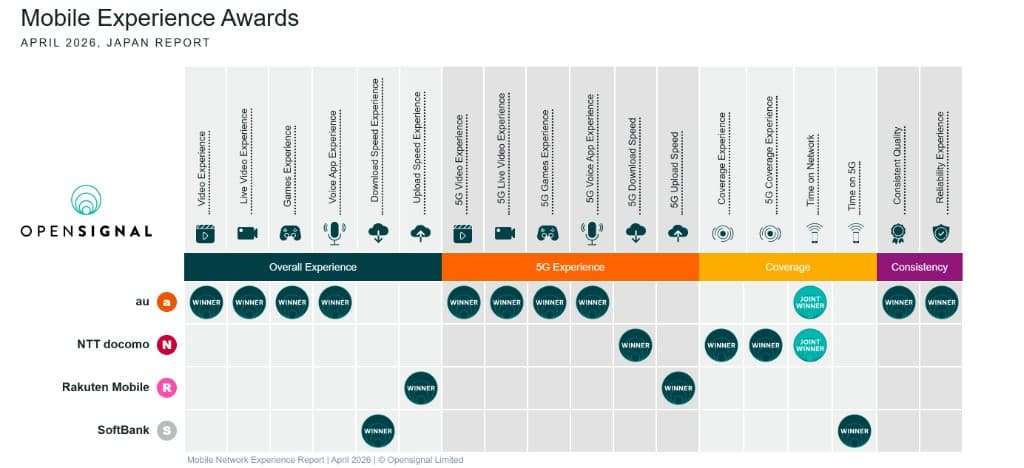
Figures that matter for a traveller:
- au (KDDI): 10 solo national awards and 1 shared. Reliability Experience at 967 / 1000 (4th win in a row). Consistent Quality at 88.3%. A sweep on video, live video, games and voice apps, overall and on 5G.
- SoftBank: keeps download speed and time on 5G (27.4%). Opensignal also notes about 17% more download speed vs the October 2025 report.
- NTT Docomo: keeps Coverage Experience and 5G Coverage Experience, the widest geographic coverage in populated areas, all tech and 5G.
- Rakuten Mobile: Upload Speed Experience at 15.8 Mbps, about 7 Mbps ahead of SoftBank. Useful for FaceTime and stories. Secondary if the real problem is “no bars in Hakodate”.
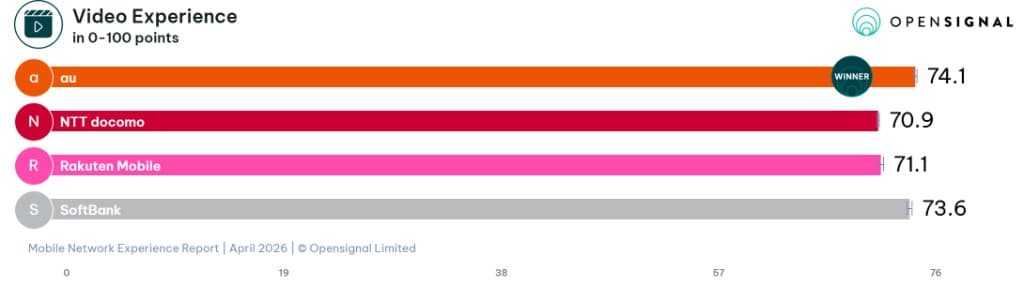
On video the gap is tight, but au (KDDI) wins (74.1 / 100), ahead of SoftBank (73.6), Rakuten (71.1) and Docomo (70.9):
Opensignal also notes: au (KDDI), Rakuten and SoftBank sit among the 2026 global winners for Time on 4G/5G (large-territory category). Japan is not a mobile desert. The delta is at the margin: villages, tunnels, ski stations, ferries, Japan’s sea edges.
TCA / MIC: who actually has the most masts everywhere
Opensignal experience is not market share. End of March 2026, the TCA counts 233.1 million mobile contracts (a Japanese person often has several IoT / data lines). Order of magnitude for the 4 MNOs:
| Operator | Contracts (end March 2026) | Traveller read |
|---|---|---|
| NTT Docomo | ~93.1 million | The network locals keep “just in case” outside cities |
| au (KDDI), Okinawa Cellular included | ~72.8 million | Urban density plus UQ (BWA) on top |
| SoftBank, Y!mobile included | ~56.9 million | Strong in town, thinner rural safety net |
| Rakuten Mobile (MNO + MVNO) | ~10.4 million | About 4% of the pie: too small for a mountain plan A |
The MIC publishes official quarterly shares. The three incumbents still hold about 97% of the subscriber market per 2026 industry summaries. For an eSIM: if the host is not Docomo, au (KDDI) or SoftBank, ask.
What carrier roaming does not tell you
Opensignal published a June 2026 note on inbound travellers: staying on EE, Vodafone, Three or an EU home roam pass in Japan is often more expensive for a worse radio. A travel eSIM flips that, if you pick the host, not the logo.
Another 2026 trap: “JAPAN Roaming” (emergency roaming between MNOs since 1 April 2026) does not apply to a tourist eSIM. It is a disaster net for local subs, not a Shibuya bonus.
Docomo also switched off 3G FOMA at the end of March 2026. No impact for a recent eSIM phone. An old 3G pocket Wi-Fi, yes.
Detailed ranking of the four networks
1. NTT Docomo, the safety net
Docomo does not crush au (KDDI) on video in town. It wins where a traveller suffers the network: Hokkaido, the Izu peninsula off-weekend, the Sea of Japan coast, shinkansen transfers, onsen villages. Think rural JR, not the Tube.
If your eSIM lists Docomo, NTT Docomo or IIJ (Docomo) (IIJ is a historic MVNO on Docomo), you have the “I do not want to debug Maps at 10 pm” profile. That is eSIM Giga’s default once the itinerary is not 100% urban.
On 5G, Docomo deploys the 4.5 GHz band (Ericsson Massive MIMO) to unclog urban nodes. In the mountains you drop back to 4G LTE. That is normal, even on a plan stamped 5G.
Three eSIMs we follow that often host Japan plans on Docomo (check the host column of the table at purchase):

CodeESIMG

CodeESIMP15

CodeESIMP
2. au (KDDI), the best typical day in town
au is KDDI’s consumer brand. On eSIM sheets you will see au, KDDI or KDDI/au: same group.
au (KDDI) wins the daily grind: YouTube on the Tokyo metro, Google Translate on a video call, WhatsApp, Instagram Reels. Consistent Quality and Reliability are the metrics that avoid “I have four bars and nothing loads”.
UQ Communications (KDDI subsidiary, BWA) adds another data layer, ~40.4 million BWA contracts at end March 2026 per the TCA. For you: au (KDDI) stays a premium urban host. Good match for Tokyo, Osaka, Kyoto.
Three eSIMs we follow if you want au (KDDI):

CodeSIMP

CodeESIMPNOMAD
CodeESIMP15
3. SoftBank, the speed, not the net
SoftBank is the network if you measure the trip in Mbps: laptop hotspot in a coworking space, 4K, backups. Time on 5G at 27.4% means, of the four, this is where Opensignal most often sees an active 5G carrier. It is not theoretical 5G coverage on a marketing map.
Outside the big agglomerations that bonus melts. Take SoftBank as a sole host only if you stay on the Tokyo, Nagoya, Osaka, Fukuoka corridors.
Three eSIMs to check if the Japan SKU names SoftBank or a host trio:


CodeESIMG

CodeESIMP
CodeESIMPNOMAD
4. Rakuten Mobile, excellent upload, bad tourist plan A
Rakuten wins upload, invests (Nokia cloud core, AST SpaceMobile satellite aimed at late 2026). For a cheap urban resident that can be enough. For a 10-day eSIM chaining Nara, Takayama and Kanazawa: too much uncertainty. Few travel plans attach to it, and when they do it is rarely the only host listed. No affiliate shortlist here: the right reflex stays Docomo or au (KDDI).
From the local operator to the eSIM: what you actually buy
So far we talked Docomo, au (KDDI), SoftBank. Those are Japanese subscriber networks. A travel eSIM is not an au (KDDI) contract. It is an MVNO / aggregator that rents capacity on one (or several) of those hosts.
Travel eSIM vs local SIM (or Japanese carrier eSIM)
| Travel eSIM (Airalo, PlanJapon, etc.) | Local SIM / eSIM (Docomo ahamo, au, SoftBank, Rakuten) | |
|---|---|---|
| Purchase | Before the flight, in 2 minutes | Counter, passport, sometimes a Japanese address |
| Local number | Rare (often data only) | Yes, useful for restaurants and taxis |
| Host | The one written on the plan | The network you chose |
| Bank SMS / 2FA | Keep your home line (UK high-street, Revolut, Monzo, PayPal) | Risk if you pull the home SIM |
| Best for | 5 to 21 days, no commitment | Long stay, need for a Japanese 090 |
For 10 days of holiday the travel eSIM almost always wins on friction. The local SIM wins if you stay months or need Japanese SMS.
Where to read the host on our site
Product pages often say “Japan 5G”. The useful field is the host operator. On eSIM Giga we normalise it (Docomo, au (KDDI), SoftBank) from supplier labels. That is the “Host networks” column of the Japan networks table: a provider, the average price per GB, and the hosts declared on the plans we analysed.
Three patterns show up in that table:
- A single host (often Docomo or au (KDDI)). The most readable: you know which network you will be on.
- Multi-host (Docomo + au (KDDI), sometimes SoftBank). The phone latches onto the best signal. Most reassuring format outside Tokyo.
- “Partners in Japan” with no name. Unknown spread: possible, but you are no longer buying a network, you are buying a hope.
Airport pocket Wi-Fi (Haneda / Narita) also rides these four MNOs. They lose on two points: a queue and another device. An eSIM installed before the flight stays the cleanest move, detailed in the Japan destination guide. Some EE, Vodafone, Three or Tesco Mobile Androids have no eSIM: use the on-site compatibility tool, not “every iPhone 14 and later”.
Recap table: eSIMs, networks, promo codes
Host “often declared”: cross-check with the live table. The same provider sometimes has several Japan SKUs.
| Provider | Typical host | Code | Offer | Review |
|---|---|---|---|---|
| PlanJapon | Docomo | ESIMG | Offer | Review |
| Airalo | Docomo / au (KDDI) | ESIMP15 | Offer | Review |
| Ubigi | Docomo | ESIMP | Offer | Review |
| Holafly | au (KDDI) | SIMP | Offer | Review |
| Nomad | au (KDDI) / Docomo | ESIMPNOMAD | Offer | Review |
| Saily | SoftBank / multi-host | ESIMG | Offer | Review |
| GigSky | SoftBank / multi-host | ESIMP | Offer | Review |
How to choose in 60 seconds
- Draw the map. Only Tokyo + Kyoto + Osaka: au (KDDI) or SoftBank is enough. As soon as you add Hakone, Takayama, rural Nara, Hokkaido or inland Okinawa: Docomo (ideally multi-host Docomo + au (KDDI)).
- Open the live comparison: Japan eSIM, sort €/GB for limited plans, total price for short stays.
- Read the host in the networks table, not the word 5G. A SoftBank 5G in Sapporo at night is not a Docomo 4G that actually connects.
- Install before the flight. Narita / Haneda Wi-Fi exists. Scanning a QR in a jet-lag queue is worse.
- Keep the home line for bank SMS (data-only eSIM).
- Turn off iCloud / Google Photos backups on cellular unless you bought a large pack or unlimited with fair use you actually read.
Estimate gigabytes for maps, video and hotspot.
Open calculatorPHONEeSIM compatibilityCheck iPhone, Pixel and Galaxy before you buy. EE, Vodafone or Three SKUs are not always eSIM.
Check my phoneHow much data for your trip in Japan?
Three typical trips, same maths as the calculator. Maps, chat, Reels or a laptop on tethering: the same gigabytes on an eSIM or a pocket Wi-Fi box. Turn off photo backup on cellular if you want the low end.
Estimate 9 GB · Maps, chat, Instagram. No Reels, no laptop.
Estimate 18 GB · Same base, plus half an hour of video a day.
Estimate 34.4 GB · One hour of phone tethering a day for the computer.
Mistakes that still cost money
- Buying a regional Asia pack for four days in Tokyo
You pay for Korea / Taiwan you will not use. Stay on a Japan plan.
Japan plans only - Staying on home roaming “because it is simple”
Opensignal’s 2026 inbound note points the other way: often more expensive and worse than a travel eSIM on Docomo or au (KDDI).
Compare Japan eSIMs - Buying too little data, or unlimited for the word
Maps, Reels and photo backup add up. Unlimited without hotspot will not save a laptop.
Size the pack - Scanning a QR on a Japan-bought Galaxy
Carrier SKUs are not the European model. Check before you pay.
Check compatibility - Assuming Rakuten covers like Docomo
Roughly 10 million lines vs 93 million on Docomo. Rarely the tourist host.
Host table
FAQ
What is the best mobile network in Japan for a traveller?
Docomo for coverage outside big cities, au (KDDI) for a typical urban day, SoftBank where 5G actually holds. A travel eSIM only inherits that host if the plan says so.
How much data do I need in Japan?
Maps, chat and social for a week in the city often land around a 10 GB pack. Reels and photo backup push a 10-day trip toward 20 GB. Laptop hotspot for two weeks usually needs 30 to 50 GB. Size it with the data calculator.
Travel eSIM or a Japanese carrier SIM?
For 5 to 21 days, a travel eSIM wins on friction. A local SIM or carrier eSIM wins for a long stay or a Japanese phone number.
How do I know which operator my eSIM uses?
Read the host networks column on the Japan comparison, not the 5G word on the pack. A plan can be Docomo only, au (KDDI) only, or multi-host.
Does a phone bought in Japan support eSIM?
Not always. A Japanese carrier Galaxy is not the European SKU. Check the model in the compatibility tool before you pay.
Sources
All external sources open in a new tab.
- Opensignal, Japan Mobile Network Experience Report, April 2026 (collection 1 January to 31 March 2026). Analyst: Robert Wyrzykowski.
- Opensignal, October 2025 report (SoftBank speed / 5G trend).
- Opensignal, Beyond roaming: how Japanese operators can win the inbound traveller, June 2026.
- Telecommunications Carriers Association (TCA), mobile contracts FY2025 (end March 2026).
- Ministry of Internal Affairs (MIC, telecom market shares).
- NTT Docomo, launch of emergency JAPAN Roaming, 18 March 2026.
- eSIM Giga catalog: Japan comparison (prices, hosts, declared 5G, hotspot).
Opensignal and TCA figures describe local networks. A travel eSIM only inherits them if the host is the one announced. And even then: QoS, fair use and MVNO priority can put your session far from a postpaid au (KDDI) subscriber. Reflex: host first (Japan table), €/GB next, promo last.